Microchip QT7 Touch Sensor
Overview
The Microchip® QT7 Xplained Pro is an extension board designed to evaluate self-capacitance touch applications with a strong focus on water-tolerant operation.
The kit demonstrates water-tolerant touch functionality using either Driven Shield or Driven Shield+, depending on the capabilities of the target MCU. The board features:
One self-capacitance slider
Two self-capacitance buttons
Eight LEDs providing visual feedback for button state and slider position
This sample provides a generic reference implementation and is intended to work with any Microchip development board and touch controller supported by Zephyr, provided the appropriate device tree configuration is present.
Requirements
A Microchip MCU board supported by Zephyr with a capacitive touch controller
QT7 Xplained Pro extension board
A device tree configuration that defines the required PTC node, example:
ptc.
Touch Configuration (Kconfig)
The following Kconfig options must be enabled for touch operation:
Mandatory options:
CONFIG_INPUTEnables the Zephyr input subsystem.CONFIG_INPUT_MCHP_TOUCHEnables the Microchip touch driver.CONFIG_INPUT_MCHP_TOUCH_EN_BTTN_MODULEEnables the touch button module.CONFIG_INPUT_MCHP_TOUCH_EN_FREQ_HOPEnables Frequency Hopping for noise avoidance.CONFIG_INPUT_MCHP_TOUCH_EN_SCROLLEREnables the Scroller module.
Optional options:
CONFIG_INPUT_MCHP_TOUCH_EN_FREQ_AUTO_TUNEEnables Frequency Hopping with Autotune.Frequency Hopping with Autotune is the recommended configuration for robust touch operation. This feature operates autonomously and provides the flexibility required to counteract electrical noise in real-world environments.
The Autotune module is a superset of Frequency Hopping. In addition to frequency variation, it continuously monitors noise and automatically tunes the touch acquisition frequency.
The touch controller performs measurements on multiple frequencies (by default three, or as configured by the host). Noise levels are monitored for each frequency. If the noise on a given frequency exceeds the configured Noise Threshold for a defined number of integrations, that frequency is replaced by another frequency from the available frequency pool.
CONFIG_INPUT_MCHP_TOUCH_DATASTREAMER_UNI_DIREnables unidirectional touch data streaming. This option is required only if touch data visualization using the Data Visualizer tool is needed.
Prerequisites
Before building the application, make sure you have updated your workspace and fetched any required binary blobs
west update hal_microchip
west blobs fetch hal_microchip
Building and Running
This is a generic sample and should work with any supported Microchip board and touch controller, as long as the required device tree bindings are configured.
Before building the sample, make sure all required modules and binary blobs are available.
Once the workspace is prepared, you can build and flash the application using the following command:
west build -b pic32cm_jh01_cpro --shield qt7_pic32cm_jh01_cpro samples/shields/mchp_qt7
Connection Details
The connection detail is available in qt7_<boards>.overlay file
Example: boards/shields/mchp_touch_qt7/qt7_pic32cm_jh01_cpro.overlay
Expected Output
After flashing the application:
Touching the buttons toggles the corresponding LEDs
Sliding a finger across the slider updates the LED position feedback
Touch functionality remains responsive even in the presence of moisture, depending on the selected driven shield mode and MCU capabilities
Data Streaming and Visualization
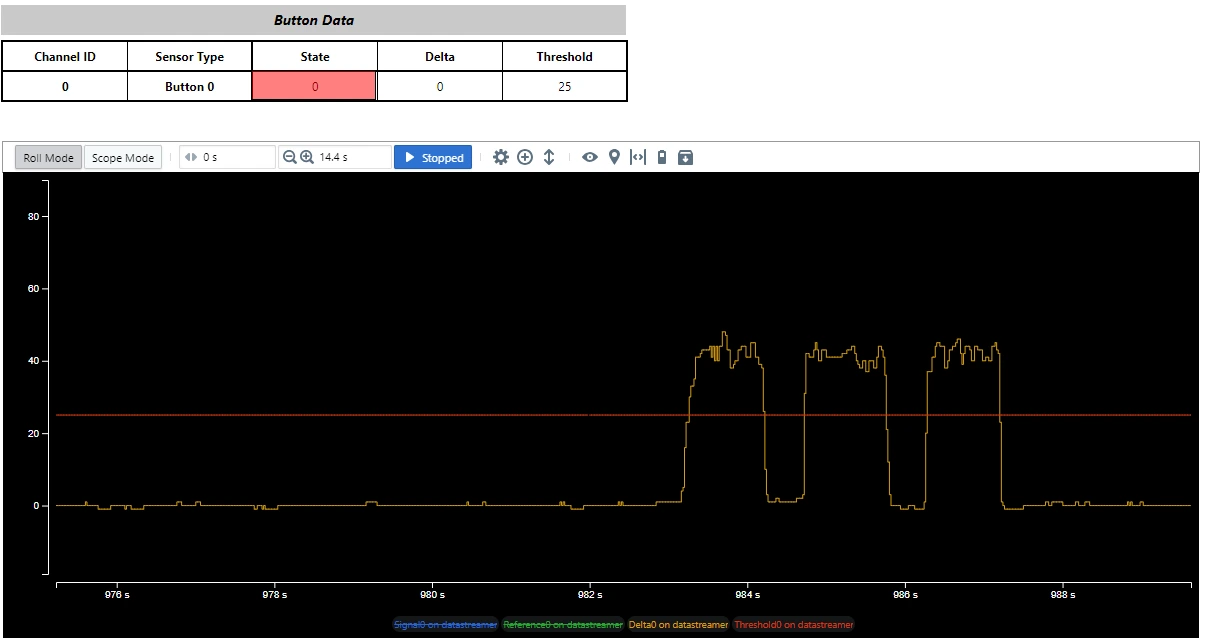
Touch diagnostic data can be streamed to a host PC and visualized using the Microchip Data Visualizer tool, which displays touch parameters in a graphical user interface (GUI).
To enable touch data streaming, the following configuration options must be enabled:
CONFIG_INPUT_MCHP_TOUCH_DATASTREAMER_UNI_DIRCONFIG_SERIAL
When enabled, touch data is transmitted over the serial interface and can be monitored in real time using the Data Visualizer GUI. This is useful for debugging, tuning, and validating touch performance.
Detailed instructions for installing and using the Data Visualizer tool are available at the following link:
Note: * Refer to the section Data Visualization * Required datastremer files are available in the sample application directory
Visualize Touch Data Using - MPLAB Data Visualizer